
Charcoal, fire, lye and barbecuing.
Bamboo charcoal is a small, satisfying loop at Daruma: solar energy caught in a stem, stored as fuel, burned once a week for cooking, and the ash saved to make lye and soap. Here is how the furnace works, and what it actually saves.
Pyrolitic alchemy · Catch and store energy
Charcoal has been used to make fires for thousands of years of human history. High temperature made it useful in the Iron Age, and high temperature and lack of smoke when burning, along with a higher energy density compared to wood, make it very attractive as a fuel for cooking.
Charcoal production here at Daruma is a thing. Reading David Holmgren's recent book RetroSuburbia, and his idea of cooking once a week using charcoal to offset our impact on the environment, as well as having some social time and satisfying our appetites, we thought we'd sit down and look at using charcoal for cooking here at Daruma Eco Farm and Mosaic School. In total we have around 75 children aged three to fourteen, and ten to fifteen adults. We have lots of people who eat cooked food, bamboo which continually grows, and the Willmann Mark IV Charcoal Furnace at our disposal to run some tests.
Using bamboo that grows rampantly here at Daruma as the main ingredient for our charcoal, dried bamboo leaves for kindling, and fallen, lopped or pruned timber for the initial fire, we are touching some important permaculture principles:
- Catch and store energy
- Obtain a yield
- Use and value renewable resources and services
More on those principles on our what is permaculture page.
Solar energy is caught and stored in the form of bamboo and wood, and our yield is primarily the charcoal, but also the residual ash for making lye, which in turn is used for making soap. The bamboo is a renewable resource, as is our human labour to harvest and process the bamboo and firewood.
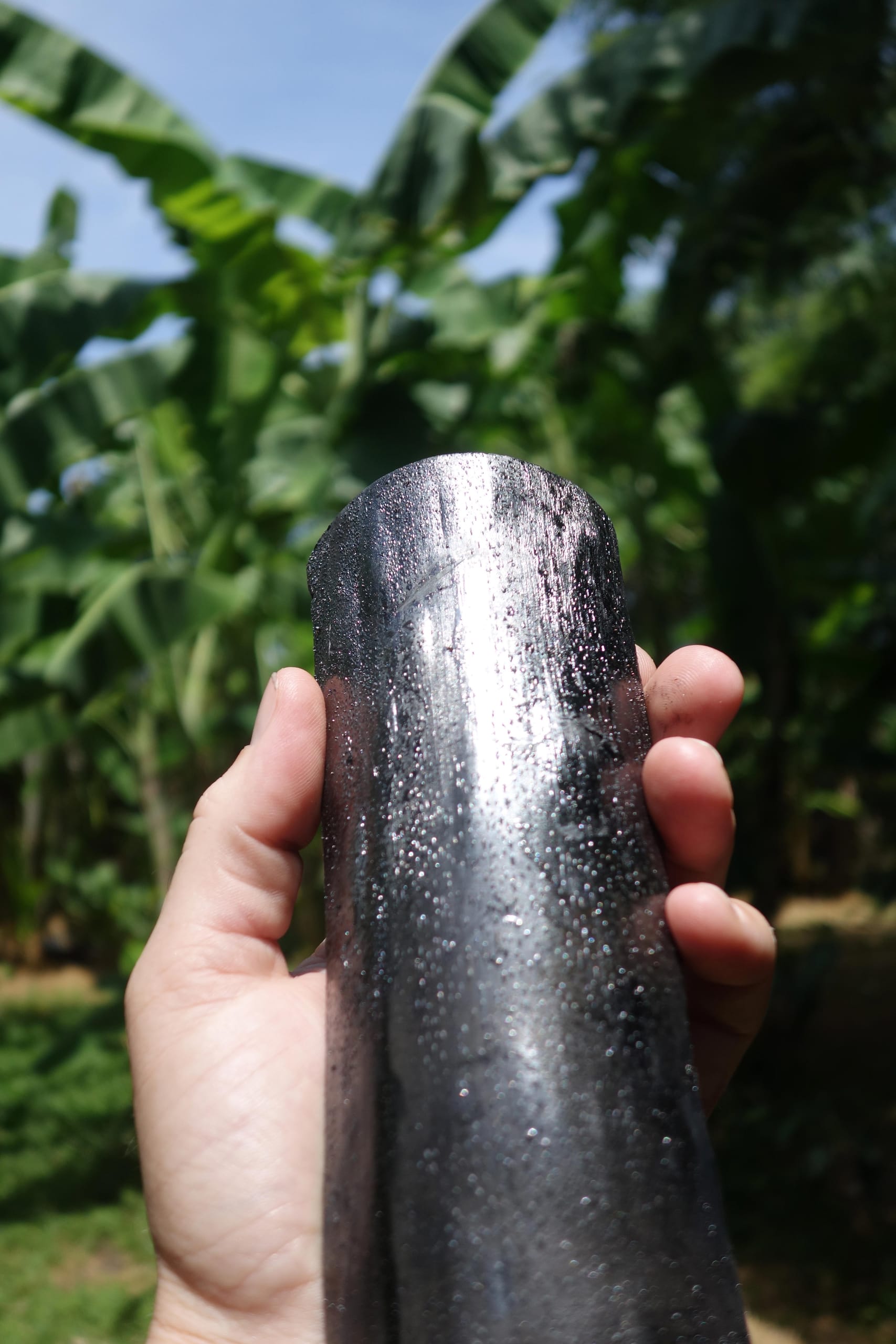
I have always been fascinated by charcoal. From my earliest memories in Wales of an uncle lighting the barbecue in the summer, to now, decades later, seeing first hand the production of bamboo charcoal here in Thailand.
It is something that captures my attention when I look at it, and of course it is one of the ingredients of a fire. And who isn't interested in fire? Small children everywhere, beware the wrath of thy parents, other adults, neighbours and the emergency services.
Fire is not so much a hazard here in the tropics. We are in Siracha, famous around the world for its hot chilli sauce, not so famous for its forest fires, because we do not get them very often.
Local laws, fire safety guidelines and good common sense should prevail whenever fire is used. In some scenarios you may even decide against using it at all: dry summers in certain areas, for example, could be a terrible place to have a charcoal fire in the woods.
Historical usage
Food, fire, and a good old social.
Charcoal has more than one use here. Some of our closest cousins eat it when they suffer indigestion, we use it for making artwork, filtering water, improving soil: the list of applications for charcoal is a long one. But here, we're looking more at cooking with it. Because if we like 1 thing here at Daruma, it is food. Eating it, especially. And fire. 2 things we like here at Daruma. We like food, and fire! And a good old social around the fire with our food. 3 things we... never mind.
As well as some of the historical uses you can find for charcoal, bamboo charcoal in particular seems to be favoured by many for making activated charcoal, perhaps in part because of local abundance, and perhaps due to some of the same reasons monkeys use it to help with indigestion: other things bind easily to it, including, I assume, indigenous and effective microorganisms that we want to reintroduce or encourage more of in our soil.
How the furnace works
Bamboo in, charcoal out.
At Daruma we favour using bamboo for charcoal production. We have an abundant supply readily available on site, and it just keeps on growing. The charcoal furnace is pretty much always ready to be used, so that is another resource we have here. It makes charcoal very efficiently, but you could make charcoal in other ways too: pile the wood up, cover it with turf, set it on fire, and come back later.
The process at Daruma is to harvest the bamboo, then cut it to lengths of approximately a foot, cutting the node as a separate "biscuit" between two cut lengths when practical to do so. The open cylinders of bamboo, the internodes, are then split in two, and these half-pieces, along with the nodes, give us good efficiency in terms of the density of bamboo when it comes to packing and stacking it in the drum.
We use a recycled 55-gallon oil drum. A sealing band secures the lid so it is as airtight as possible, clamped down with a bolt. Inside, a sturdy iron base holds a central pipe sticking up an inch or two, locating into a hole in the bottom of the barrel and running down directly into the furnace below: effectively the only outlet for gases that vaporise out of the bamboo during firing. Those gases are very combustible, and we usually see much of them as smoke in ordinary fires, due to incomplete combustion (read: inefficiency). Here, they are one of the things that make the furnace so efficient: the initial fire is only required to get the bamboo up to a temperature at which vaporisation starts, then those gases fuel the fire below to complete the pyrolysis inside the drum.
The sealed drum goes into our cylindrical kiln, stacked concrete rings a metre across and lined with firebrick. We top it with a reinforced concrete lid, sealed with wet mud, with a four-inch hole for airflow while the fire is first lit.
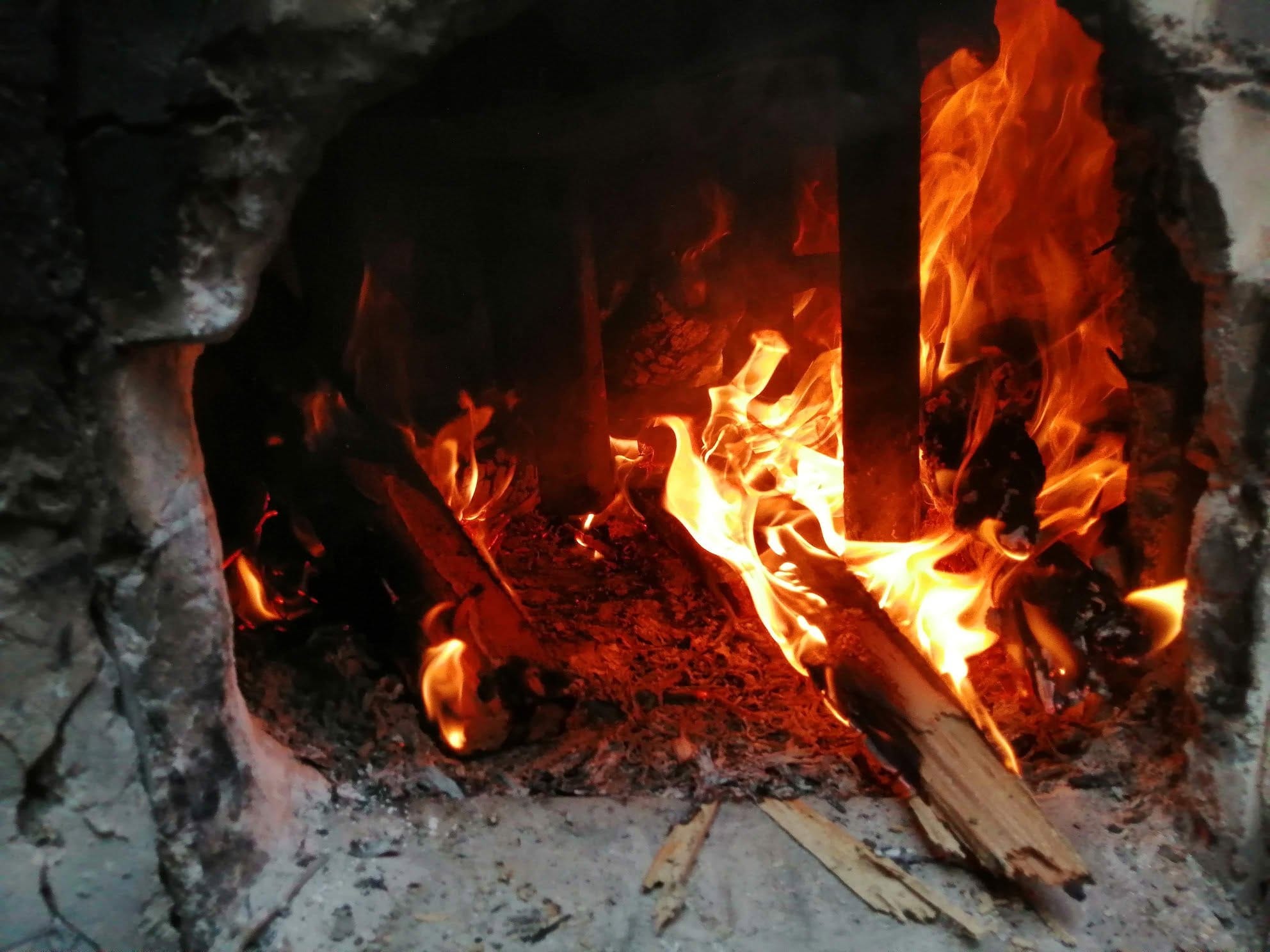
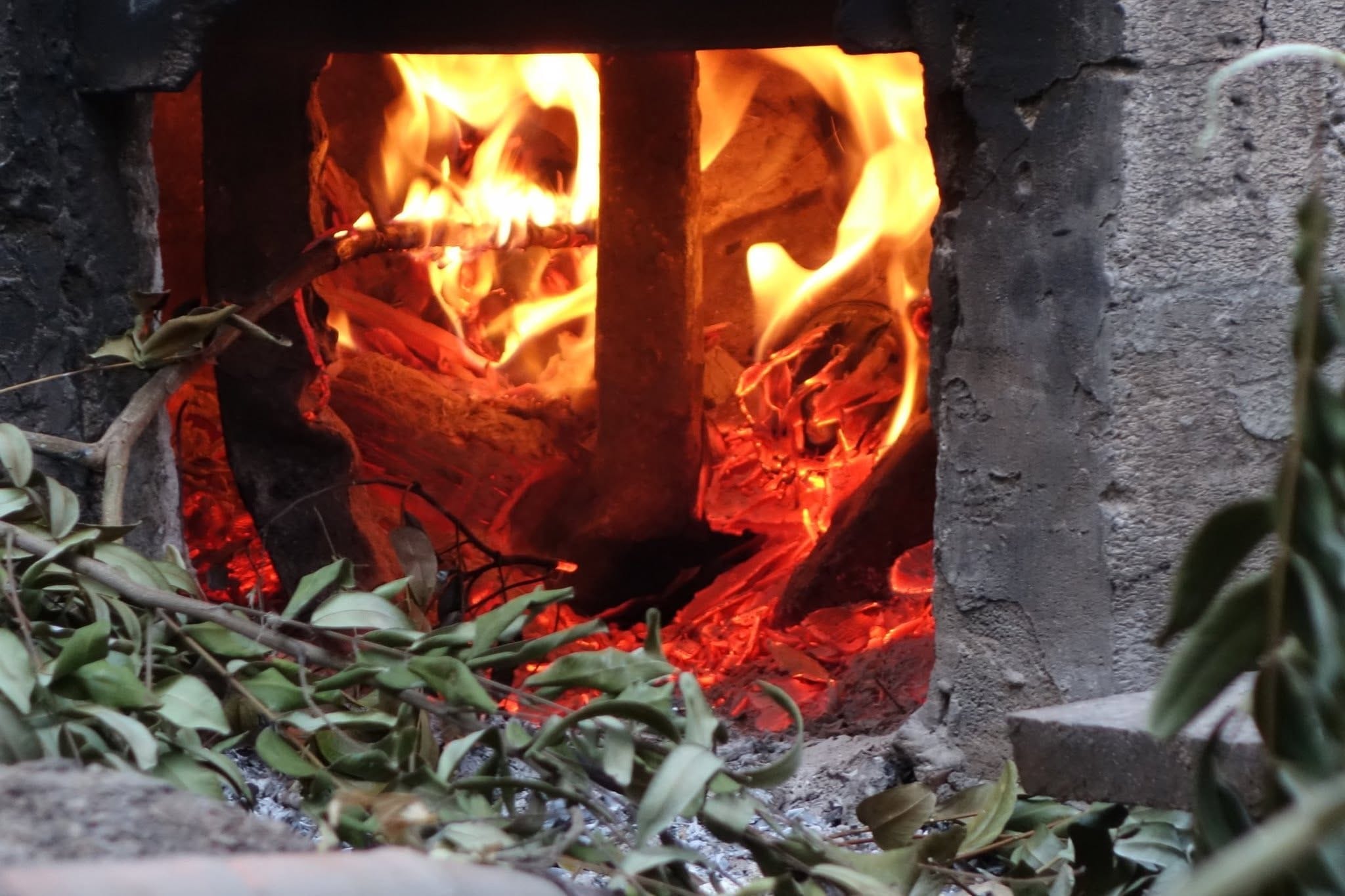
We typically use dry bamboo leaves as tinder, and for kindling there are plenty of small twigs and branches fallen from the many trees here, plus larger diameter wood from regular tree trimming. Those are the basics for our fire. We try to push the burning wood and embers clear of the pipe at the bottom of the barrel so nothing obstructs off-gassing. Temperatures measured with a thermocouple have exceeded 1,000 degrees C inside the furnace.
Sometime between thirty minutes and an hour or so after lighting the fire under the barrel, off-gassing occurs. This can be quite spectacular, with flames coming out of the load door at the front up to six feet high. We then know that volatile and combustible constituents in the bamboo are vaporising and being forced out of the hole in the bottom of the barrel, through the pipe underneath, and into the fire below. After this we do not add any more wood to the fire, as it is self-sustaining on the remaining coals and flammable gases from the bamboo.
The next day we remove the lid and take out our latest batch of warm, freshly baked charcoal. Some of the colours evident on the surface of the charcoal after being removed from the drum are spectacular: the surface is shiny, and some kind of iridescence creates a mixture of shimmering blues, greens, yellows and purples.
One of the by-products of firing up our furnace is ash. This we use to create lye, to make soap and detergents for use in the school, kitchens and bathrooms.
Rough numbers only, worked from our own LPG use. Swap one cooking day a week, on school days, for bamboo charcoal, and that is around 127kg of CO2 a year left in the ground.
Show the arithmetic
So, looking at barbecuing one day a week, when school is open, here are some approximate numbers.
- One LPG bottle in the kitchen is 15kg.
- We buy one or two bottles a month, say 1.5 a month: 15kg by 1.5 is 22.5kg of LPG a month for cooking.
- 3,027 grams of CO2 are produced per kilogram of LPG.
- 22.5kg of LPG a month by 3,027 grams is 68,100 grams, or 68kg, of CO2 a month.
- Multiplied by 12 months, that is approximately 816kg of CO2 per year in total from cooking with gas in the kitchens.
- There are approximately 22 school days a month, say 264 in a year, allowing about 11 weeks off for school holidays.
- That is 816kg divided by 264 days, so 3.1kg of CO2 per school day.
So, say we cook every Friday at Daruma with charcoal, on school days (75-plus children, 10 to 15 adults). Accounting for school holidays, that would be maybe 41 days, multiply that by 3.1kg CO2 each day and you get 127kg of CO2 per year. About 127kg of CO2 saved per year, by cooking one day a week using bamboo charcoal.
Of course, we could also add in the production and distribution footprint of LPG per kilogram, offset by the footprint of the saw and electricity used to cut the bamboo if we don't use the machete instead, and so on. For cooking, we're not quite in the same ballpark as, say, heating or hot water: a typical European house can run to 5,000kg of CO2 a year for heating alone, and a rocket mass heater on a near carbon-neutral fuel could make a far bigger dent in a figure like that. Barbecuing once a week still makes a difference, though: it reduces an individual or household's CO2 emissions and its reliance on fossil fuels and the grid, and is a different, more sociable way to cook.
Other conversions, for reference: butane holds 13.7kWh per kg. A litre of LPG weighs 550 grams, so 1kg of LPG is 1.818 litres, working out to 1,665 grams of CO2 per litre of LPG, or the 3,027 grams per kilogram used above. Propane emits about 139 pounds of CO2 for every million Btu burned.
David Holmgren's case for barbecuing
Catch and store energy, again.
From the point of view of permaculture, charcoal most definitely applies to the principle "catch and store energy," and charcoal production long term is close to being a carbon neutral process. Even if processed hundreds of miles away, and transported to your home, when compared to fossil fuels charcoal has a fraction of the emissions per unit of energy that we use.David Holmgren, RetroSuburbia, p111, 112
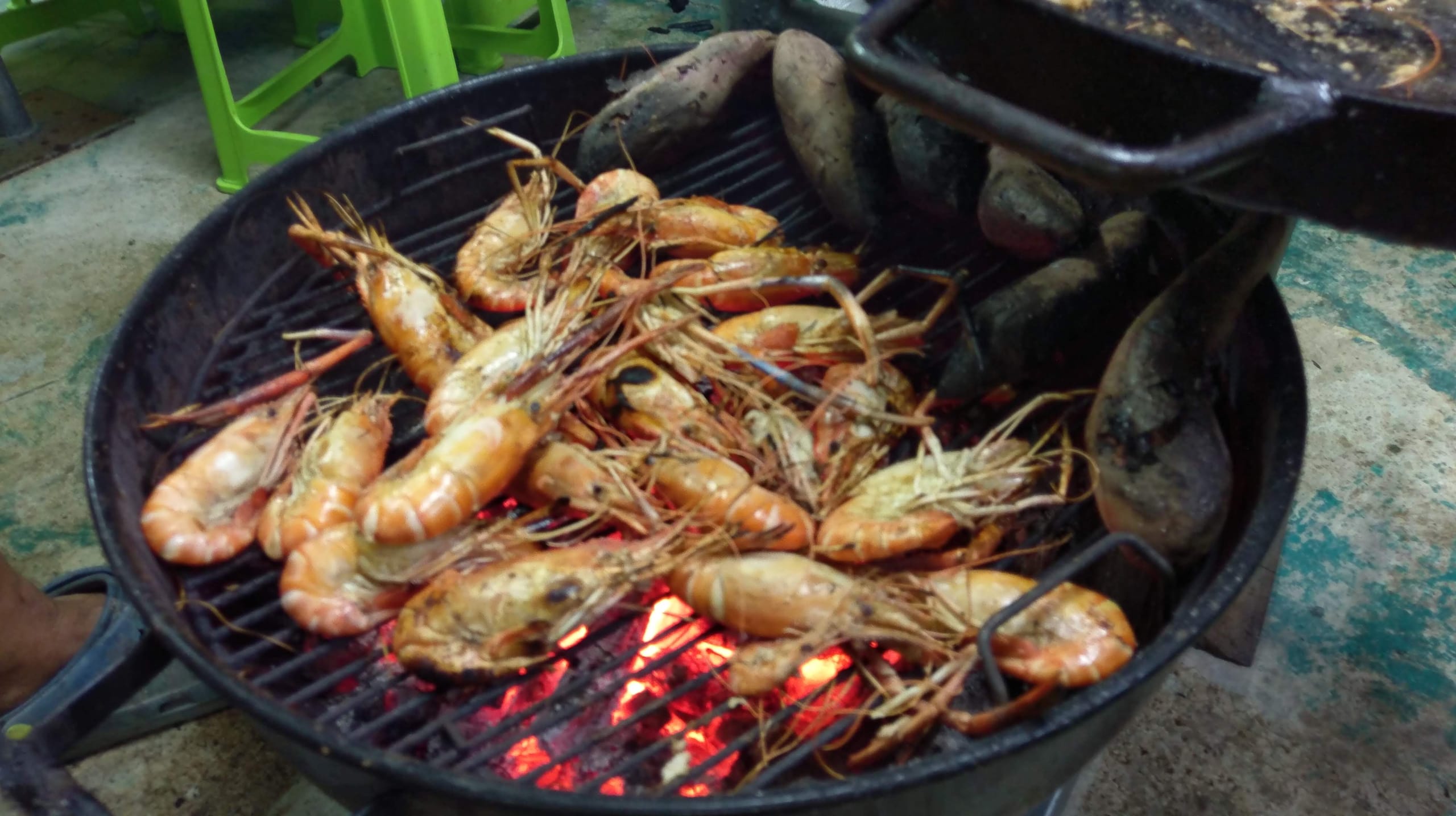
One of Holmgren's ideas is that we barbecue once a week instead of cooking with gas or electric, to reduce our impact on global resources. Sounds interesting, right? Who doesn't like a barbecue?
Okay, so a wet summer in Wales might not be the best for outdoor barbecuing, alright. But still, there may be some in the valleys with covered outdoor space, lean-tos or other spaces that are good for barbecuing.
Certainly here at Daruma in Thailand, we have the climate and raw materials for this to be a feasible way of cooking once a week. And I like a fire now and then. That much may already be apparent. I just thought I should mention it again.
At Daruma we also have two types of tree that can be used for smoking meats, one of which is the Madras Thorn, so they are also a valuable resource.
Further reading:
Learn the food and process side of permaculture
This is what we teach on Alchemy.
Cheese, fermentation, mushroom cultivation and processes like this one, all part of Daruma's Alchemy courses, returning to the calendar as the school grows back.