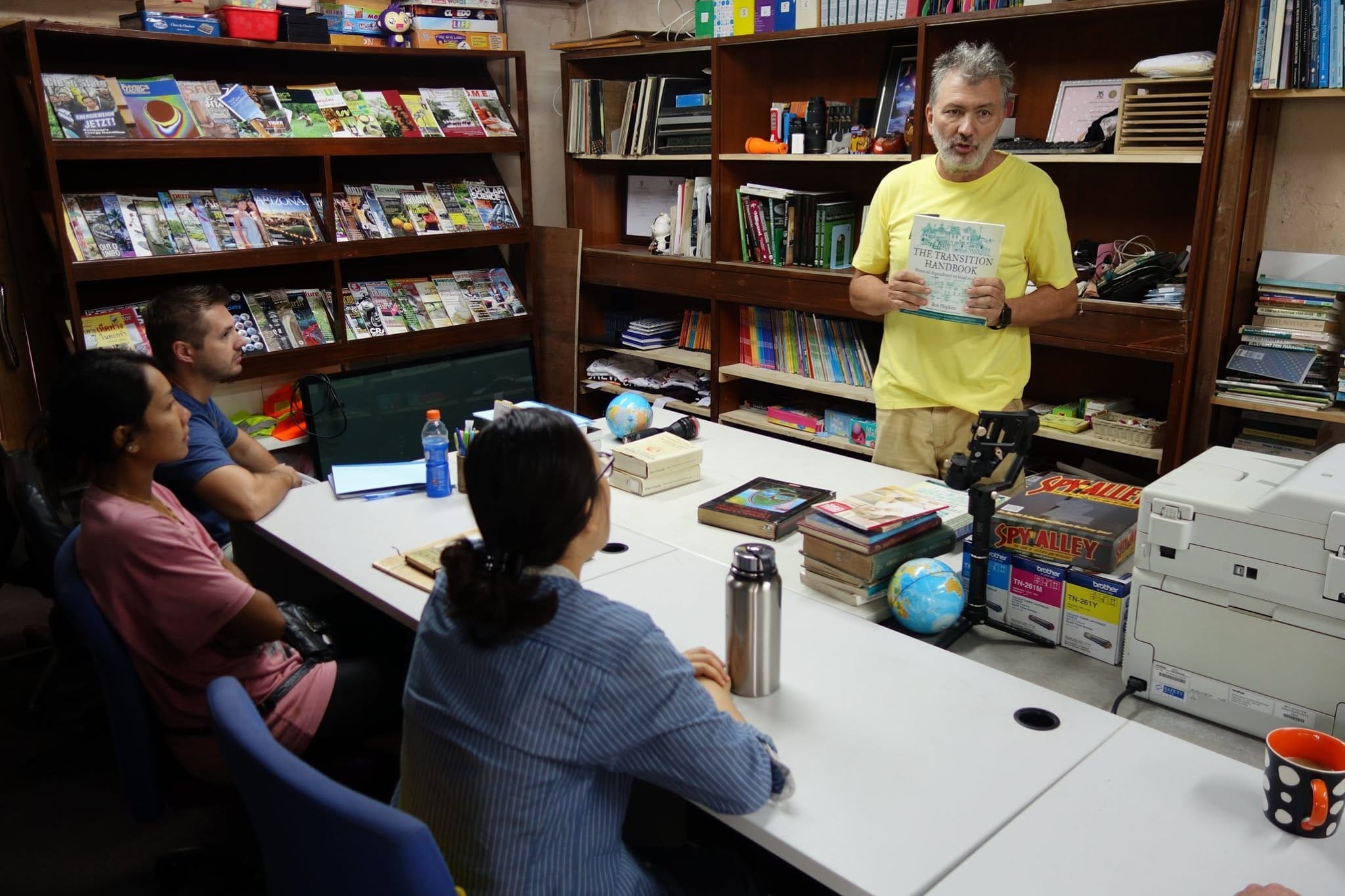
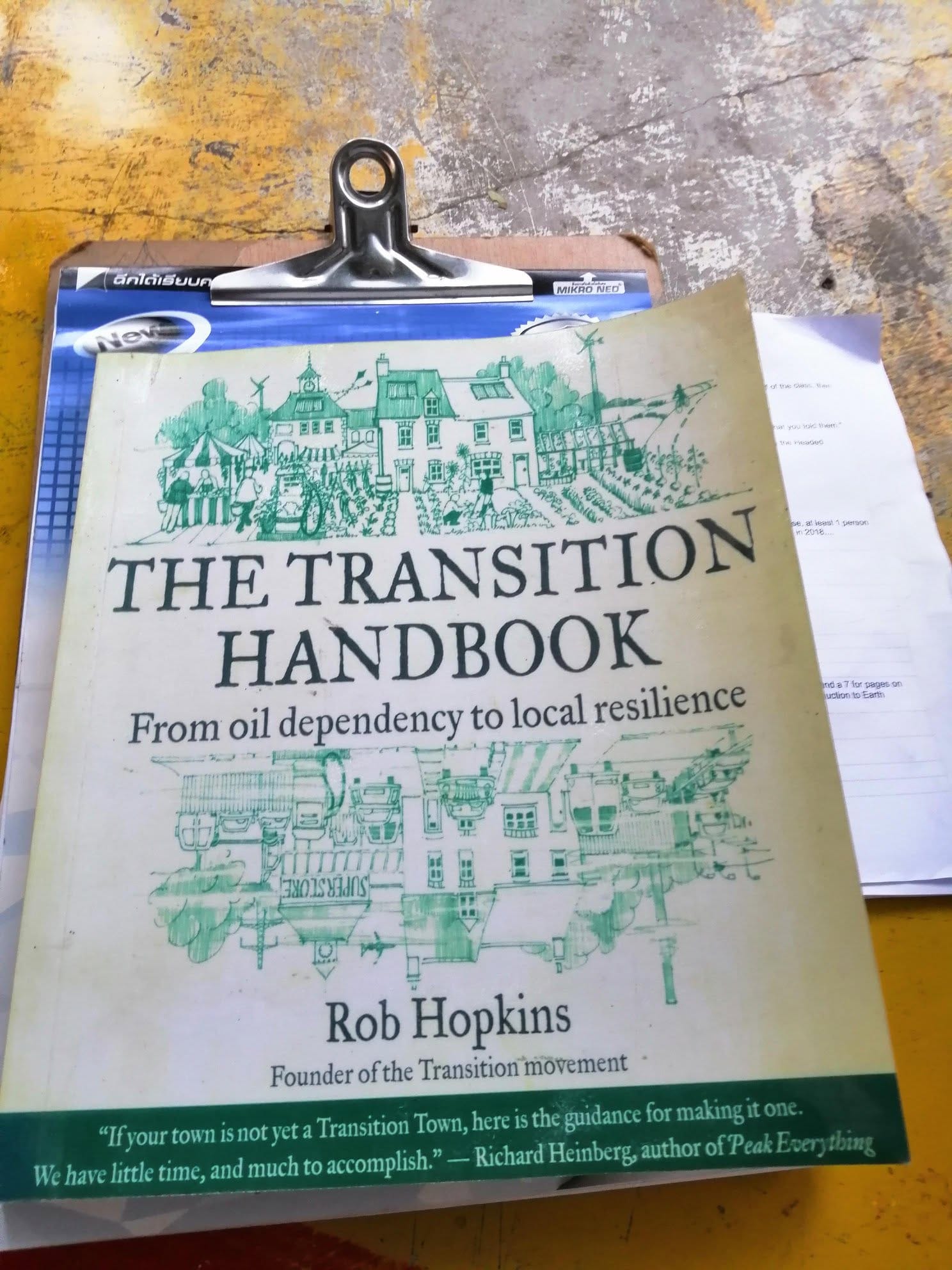
The Transition Handbook
From oil dependency to local resilience: Rob Hopkins' handbook for community-scale change, reviewed by a PDC student partway through their course.
The Transition Handbook is about solutions to a world in which oil is becoming scarcer, more expensive, and harder to find and extract. Community-driven, community-created Energy Descent Action Plans are the desired outputs.
The book recognises that nearly everything we experience materially in modern life is made possible by cheap oil, whether producing goods or moving them to us. It is cheap fossil fuel that has enabled the inequitable phenomenon of globalisation, at a scale not seen before in human history.
This is not, however, a book of doom and gloom. It sets out a positive vision for an abundant pathway to the future: a move toward more localised living, reversing decades of declining local resilience, and celebrating the process along the way.
The move towards more localised, energy-efficient and productive living arrangements is not a choice, it is an inevitable direction for humanity.Rob Hopkins, 2008
True to its title, the book is a handbook. Alongside its vision, it offers practical steps: setting up local currencies, resolving conflict between people, and helping local groups form and multiply in communities across the UK and beyond. The Transition Town movement it describes is a flexible, whole-system framework for finding solutions, whatever energy-descent scenario a community ends up facing.
Rebuilding resilience as well as cutting carbon
Rebuilding resilience is one of the book's central ideas for coping with energy descent after peak oil. Hopkins points to evidence such as UK truckers' strikes to show how brittle our current infrastructure really is, however secure it might feel day to day.
Comparing sustainability to resilience is where the Transition concept becomes clear. Recycling plastic, glass or paper may improve sustainability, but it does nothing for a community's ability to survive transport grinding to a halt, which touches everything from fuel and food deliveries to the water supply, if the pumping stations lose power.
The book names three ingredients of a resilient system.
- Diversity
- More elements and connections in a system, including connections to other systems, allow small local changes to create unique practices and cultures: similar to neighbouring solutions, but never identical.
- Modularity
- How self-contained the parts of a system are. More modularity means a shock in one part, such as the banking crisis or bird flu, is less likely to cascade through the whole.
- Tightness of feedbacks
- Small, slow solutions affect the rest of the system gradually and can be corrected quickly. Globalisation sits at the opposite end, with long, rigid connections between distant parts of the whole.
The book's own metaphor is an oil tanker with no baffles between its tanks. Without compartments, the whole load sloshes as one, and a single change of course can capsize the ship even without any outside shock. Add baffles, modularity, and each compartment absorbs the movement instead of transmitting it to the rest.
What is a Transition Initiative?
The phrase began as Transition Towns, though the idea has since spread well beyond towns. Jeremy Leggett's phrase for it, quoted in the book, is scalable microcosms of hope. The clearest way to hold onto the concept is to remember its purpose: helping people create their own Energy Descent Action Plans.
Where conventional environmentalism tends to focus on the individual, using fear-based campaigns and protest, the Transition approach is holistic, community-built, and positive by design. It rests on four key assumptions.
- It is better to plan for an inevitable lower-energy future than to be taken by surprise.
- We currently lack the resilience to absorb peak-oil energy shocks.
- We have to act now, and act collectively.
- Collectively, we can build richer, more connected ways of living within what the planet can supply.
From there, the book sets out twelve principles for running a Transition initiative, from Open Space meetings to setting up steering groups and planning their own end, honouring elders, and reskilling people so that low-energy ways of working are not lost entirely.
What it looks like on the ground
Some of the clearest practical examples come from the Transition Network's own video channel rather than the book itself: community funding to buy a grocery store that then becomes an outlet for local growers, bakeries and cafes run as community-supported businesses, small solar farms funded entirely by residents, food planted in beds once used for flowers, or not used at all. The possibilities are limited only by the imagination of everyday people and the freedom built into the Transition concept. There are no single right answers in the book: the right answer is whatever your own community implements, in your own area.
The same source also points to what has gone wrong. One project failed over a breakdown in relations between its members, which is a plain, sad story. The lesson learned, that if people cannot work together at least most of the time then nothing works at all, pushed the movement toward a more people-centred focus: facilitating groups to work well together, on the understanding that everything else collapses if that fails.
The verdict
What strikes me most, during and after reading, is how hard the book is to pin down, much like permaculture itself. That should not surprise me: Rob Hopkins taught permaculture for a decade before writing it, and permaculture is referenced throughout.
The outcome is easy enough to state: helping people create energy descent action plans. What that looks like in practice is as varied as the people who make up the groups doing it, in locations all round the world.
I like the book a great deal, have enjoyed the episodes of The Permaculture Podcast featuring Rob Hopkins, and have watched plenty of the Transition Network's videos besides. Reviewing it during a busy PDC, with limited time, I would feel wrong giving it a star rating, but I will say this: anyone interested in permaculture, in rebuilding community, or in being better prepared for the next national or global disruption will likely get a great deal from it.
It does a genuinely good job of explaining something nebulous, creative, and different depending on where you choose to look at it.
Find out more at the Transition Network.
More from the PDC reading list.
This review was written during a Permaculture Design Certificate at Daruma, where an optional book review is one way students engage with the reading list. See the rest of the collection, or browse the shelves the reviews are drawn from.
More book reviews Visit the library