
Permaculture Book Reviews · Miguel Pereira
Ecological and General Systems.
An Introduction to Systems Ecology by Howard T. Odum, 1983.
Long before permaculture had a name, Howard Odum was drawing the diagrams for it. David Holmgren has credited this book with giving the whole design system some of its clearest thinking tools, and it is easy to see why once you start reading.
David Holmgren has said Odum "provided a theoretical framework and conceptual tool which was critical in the development of the permaculture concept," describing a systems approach to human and environment interactions that uses energy as a currency, a single unit to compare and quantify the whole spectrum of natural and human-made elements and processes.
The environment has organisms, water, air, human machines, soils, cities, forests, lakes, oceans, and connecting them all are flows of energy, including those associated with matter and information.
Odum's case is that humanity's knowledge of the environment, and of all the relationships between the elements inside it, including ourselves, was never treated as critical to our survival. For most of history that was a fair assumption. It stopped being one once our actions became capable of affecting a whole ecosystem at a time, and Odum wrote this book from the point where that shift was already well behind us.
"Because humans are in the system," he says, "they see so much detail that they are often bewildered." His answer is the model: a deliberately simplified stand-in for a system too complex to hold in the mind all at once.
People can learn and understand simplified models even if they cannot perceive the full system at a time. Model building becomes even more necessary if the human mind is to grasp and understand the performance of the system of which it is a tiny part.
After introducing systems and models, Odum spends the middle chapters describing the different variations of systems designs and layouts, in places technical enough that a general reader will want to slow down. The last third turns to interpretation: the roles of production and consumption inside a system, worked through examples that run from a cow's relationship with its own digestive microbes to the workings of a whole country's economy.
Two laws recur throughout. The first is the conservation law: energy is never created or destroyed within a system, only converted from one form to another. The second is that every storage and process along the way loses some energy as heat. Once you hold those two laws, and the habit of drawing the diagram, most of the rest of the book is a matter of applying them patiently across scales, from a compost pile to a national economy.
It is almost like computer programming, applied to permaculture.
None of this needs to end up as a formal diagram to be useful. Understanding a system, its parts, its relationships and its energy pathways, sits close to the daily work of a permaculture design, whether or not you ever draw the arrows. Odum put the ambition more plainly than most: the most valuable models are simple enough to hold in the mind, yet rich enough to explain, predict and inform a decision.
So get out there, and design your backyard as if you were designing the world.
More from the shelf.
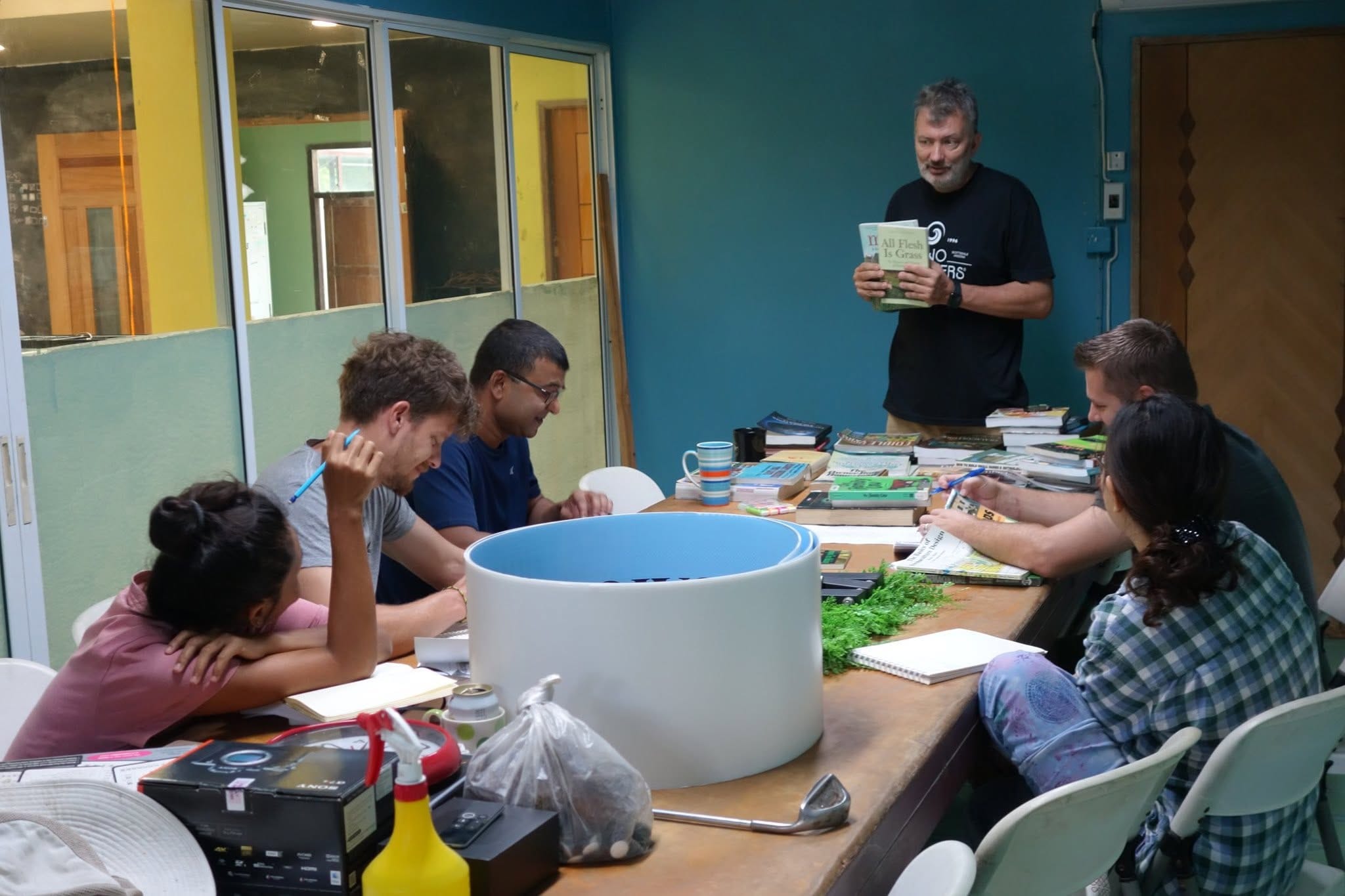
This review sits alongside the rest of the reading list built up over a decade of Permaculture Design Certificates, and the physical shelves it came from.