
“Incredibly welcoming, green, peaceful and laid back place, great learning environment whether the school or the courses ran here, fantastic market 10 minutes walk away, train station across the road.”Frank la Mol Google review · Local Guide
Student & volunteer voices
What people say when they leave.
Since 2007, Daruma Eco Farm has welcomed more than 800 volunteers, interns and permaculture students from over 36 countries. Some of them wrote about it. Here is a selection of their reviews, letters and blog posts, in their own words.
800+ students, volunteers & interns36+ countriesSince 2007
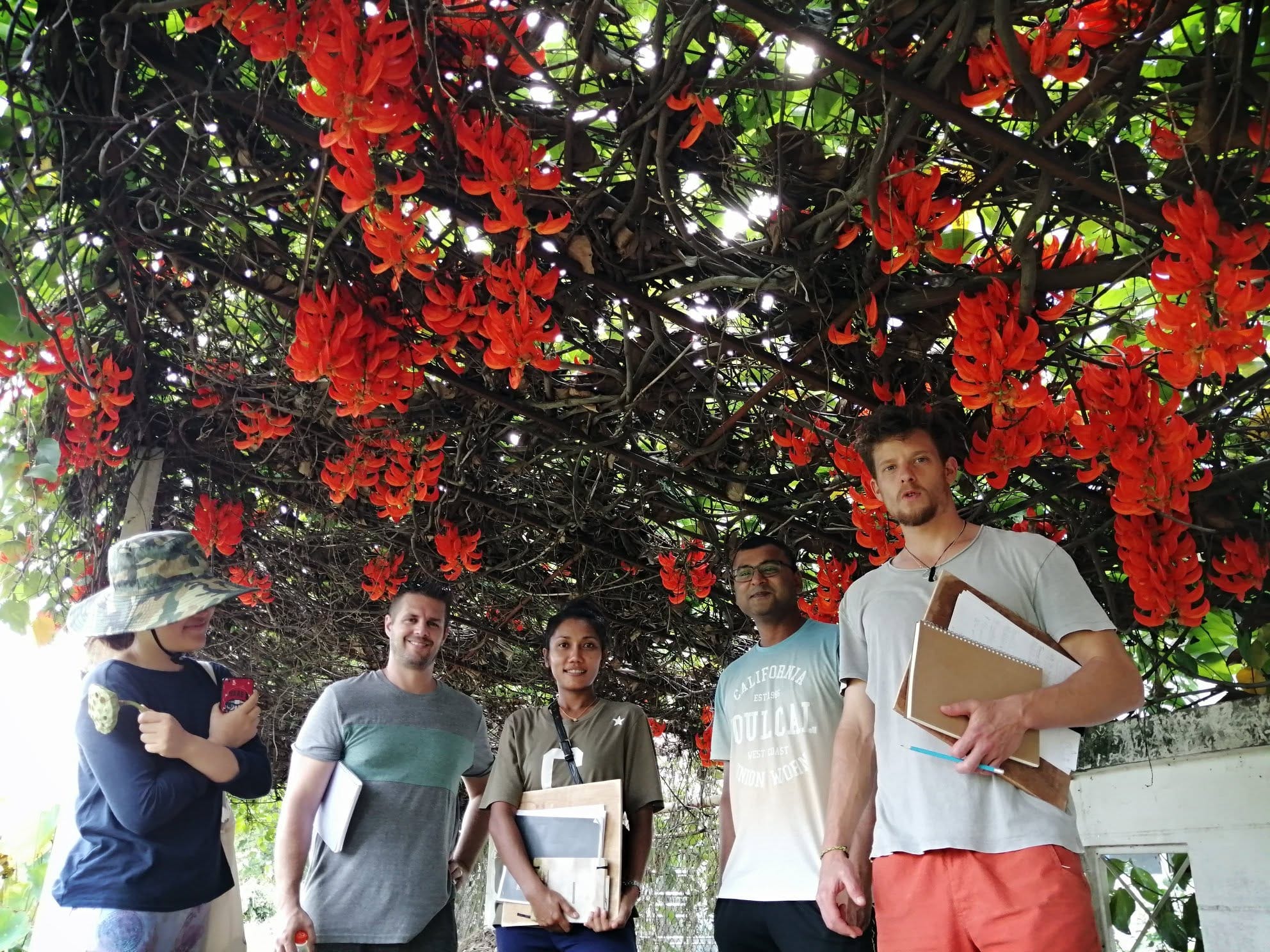
A course graduate
“I came to the farm a complete permie novice and left with my world turned upside down, with healthy soil now being my heaven.”
 Rachael Maysels, Environmental Science PhD student, Universidad del Cauca, Colombia
Verified reviews
Five stars, on the record.
4.9
A partner in permaculture education
From a fellow teacher.
Kyle Holzhueter PhD, Permaculture Center Kamimomi, Architectural and Regional Ecological Design Studio, Nihon University ↗Neil Willmann is a close friend and partner in Permaculture Design Education. Over the past ten years Neil has designed and built Daruma Eco Farm, a premiere permaculture education and demonstration site in southeast Thailand. Daruma Eco Farm features organic gardens and rice fields, livestock husbandry, natural building, appropriate technology, and also hosts Mosaic School, an alternative international school.
Neil is an encyclopedia of permaculture wisdom, providing Permaculture Design Courses at Daruma Eco Farm and also travelling internationally to teach and consult. Together I hope we can continue to support permaculture in both Thailand and Japan.
Course graduates
In their own words.
PDC and Agile PDC alumni wrote back with their full letters. Here is what they said, unedited beyond a typo or two.
Rachael Maysels
Environmental Science PhD student, Universidad del Cauca, Colombia, co-founder of Tierras del Sham Educational Research Center
As a graduate from the 2 week permaculture design course at Daruma Eco Farm, I could not recommend this experience enough. Set in a beautiful and convenient location, this dynamic and abundant farm is an excellent classroom for budding and developing permaculturists. With amazing teachers, fascinating ecology, and innovative systems, this is the ideal location to study permaculture.
Daruma Eco Farm is a wonderful education center and a successful example of caring for the earth, caring for the people, and sharing abundance. I was a student in the 2 week permaculture design course which incorporated hands-on farming and building, design practice, and classroom work. Earth building, seed starting, land assessment, all of the practical aspects were incredibly empowering and built a foundation of land practices I still use today. The academic aspects of the course were fascinating, from calculating terrace sizes, to studying ecological interactions, to presenting an integrated landscape design. This course exceeded my expectations and the literature I had found on permaculture. I am forever grateful to my breakthrough experience working and learning with Daruma Eco Farm.
From the natural swimming pool, to bamboo hammocks, to terraced vegetables, and straw bale buildings, Daruma Eco Farm is a paradise of permaculture. An easy day trip to Bangkok, this educational center is conveniently located to incorporate a permaculture design course during travels or study. The 2 week course I participated in was extremely well planned, interactive, and academic. I was able to learn leaps and bounds about biology, land design, ecology, engineering, and building, and the integration of locals in the farm staff allowed me to expand my Thai language and cultural knowledge as well. I came to the farm a complete permie novice and left with my world turned upside down, with healthy soil now being my heaven. The practical work we did daily, such as transplanting, propagating, land assessment, earth building, and water capturing, were processes that one cannot learn in a classroom. The hands-on experience we had during this PDC was what separated this course from countless others I had researched. We were able to complete full projects such as building a rammed earth structure, a straw bale library, and terraces, while still learning the science behind it all. It was a great balance of real life practice and classroom and group work. Accommodations were cozy, and I made wonderful lifelong friends with the fellow students. I am still practicing a life of permaculture, now on my own farm in Colombia, using everything we learned in my initial PDC. I will be forever grateful to Daruma Eco Farm for launching me on this amazing path to earth regeneration.
Sue Rae
Graduate, Daruma’s first Agile PDC, New York
I graduated from Daruma’s first Agile PDC. My background is in the corporate world but on the creative side, having worked for PolyGram and Universal Music, and I moved to New York and spent the last 5 years of my career working for Google’s Creative Lab in New York.
I took a sabbatical from Google and went to Thailand to study with Neil to learn about permaculture in a concentrated and concise way. In the 2 weeks I spent with Neil we were encouraged to think deeply about global crises: economic, social, ecological and climate change, including energy supply and use.
I was fascinated by Neil’s in-depth knowledge of the Permaculture Design process and ethics, and the incredible working, hands-on set up he has at Daruma Eco Farm, which shows permaculture principles in action. As well as this incredible knowledge, we also learned about thought tools including SWOT analysis, MOPP, SMART criteria and LogFrame techniques, as well as survey analysis.
Little did I know that this design thinking would help me pivot to a new career in just under a year after returning to New York. It helped me crystalize my passion for helping people and take a considered leap of faith to launch my own business.
My time at Daruma was educational and hugely transformative in a life changing way. I cannot recommend Neil and the Agile PDC more highly. Go study with Neil and see for yourself.
Darren Roberts
InterConnected, later Course Coordinator and apprentice co-teacher at Daruma
I learned an enormous amount during my relatively brief time studying my PDC at Daruma. Having discovered permaculture and its principles whilst working with others on the 4 Person Eco Home in Taiwan, I was fairly new to permaculture, but had read one or 2 books, and watched a fair amount of video content.
My personal interests before doing my PDC were mainly earthen homes, rammed earth, natural building techniques and so on. But the scope of subjects within permaculture that could be explored, studied, and importantly for me, actually worked on with my own hands, this had captured my attention.
It seemed that whatever I had an interest in, whether it was the practical aspects of improving the soil microbiome, composting, effective microorganisms and indigenous microorganisms, or how to design and implement a permaculture project from start to finish, specific design methodologies, natural building techniques, or the myriad other branches of scientific enquiry that can be pursued, I certainly left Daruma feeling as though I had learned as much as I could absorb, and more, during the course.
The depth and breadth of Neil’s permaculture knowledge, along with his obvious talent at teaching and mentoring, was something I very much appreciated. Any topic I asked further questions about, Neil had volumes of pertinent information on tap to either help me understand the basics, or broaden and deepen my understanding. One of the best teachers I have studied with.
My class notes alone are filled with enough information and references to stimulate years of research and application, if I decided to.
The PDC at Daruma was as thorough academically as I had hoped for and more, with plenty of opportunities to explore the practical application of much of what I was learning. There are many natural building techniques employed on site, from straw bale to rammed earth (my pet favourite interest), poured earth, and compressed earth brick walls running hundreds of metres around the farm. It is a fascinating place to come and learn, both from a hands-on practical, and academic or theoretical point of view.
My experiences during the PDC, and the time spent there with Neil acting as both a teacher and mentor, led to me taking the opportunity as a Course Coordinator and apprentice co-teacher at Daruma. This in itself has been invaluable in further expanding my knowledge and experience, not just of permaculture and natural building techniques, but also seeing first-hand what it takes to establish and maintain an ecovillage and intentional community such as Daruma and Mosaic School.
interconnected.me (site now offline)

In the press
“Permaculture in the Thai classroom!”
Writer Bronwen Evans visits Mosaic School for Thai Permaculture and finds a school that swaps hourly bells for a single semester-long theme — Origins — with children aged 5 to 15 choosing their own classes, from the origin of money to the origin of the universe.
The piece traces how Neil and co-founder Frances Underwood grew an improvised “Integration Day” into a whole philosophy of self-directed learning — and why Neil, who studied under permaculture co-originator Bill Mollison, believes education is where permaculture matters most.
Bronwen Evans · thaipermaculture.org · February 2026
From the road
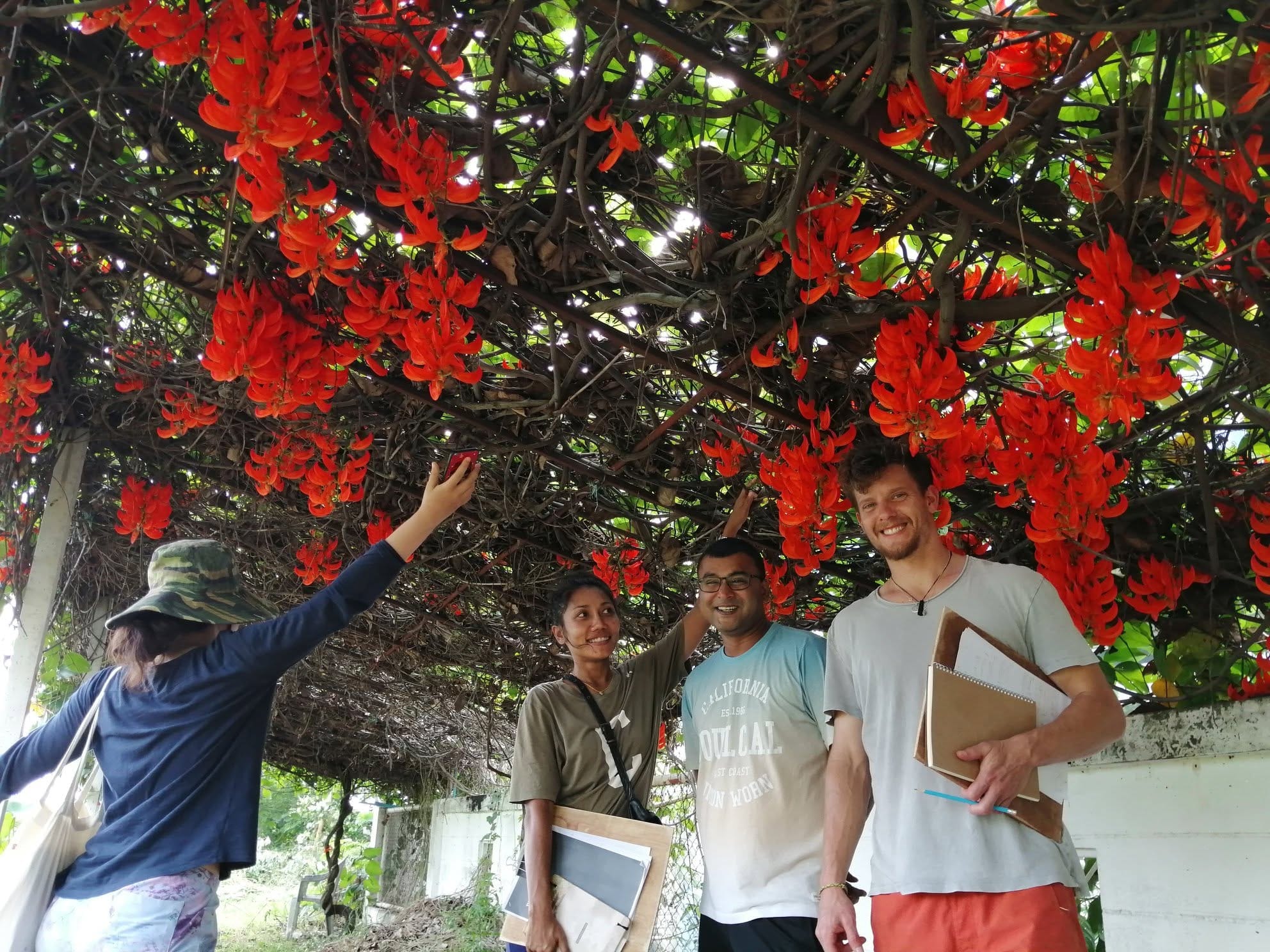
WWOOFers & travellers.
Daruma has hosted WWOOF volunteers and passing travellers since 2007. A few of them kept blogs.
-
“The past ten days have been absolutely fantastic. I was able to get in touch with Neil, a friend of a friend of my father’s who lives here in Thailand and has an organic farm about an hour outside of Bangkok. He is part of an organization called WWOOF, World Wide Opportunities on Organic Farms. The idea is that people, anyone, pays a small fee to join the website and get access to contact information for organic farms in certain countries.”
Karina · from her travel blog, 2009 (post no longer online) -
“Daruma Eco Farm is a permaculture farm south of Bangkok. There you can see how volunteers, staff, animals and plants live together in a very special environment, including hydroponic systems. We stayed there a few weeks and learned a lot about permaculture at work in the garden, as well as building frames for duckweed. The chickens, including the very noisy white species that produce low cholesterol eggs, would be the first thing we heard at early hours of the morning, just before being greeted by the four cats and Maxi, the dog. Vegetable beds and fruit trees, including the superfood tree Moringa, were carefully laid out and planted, and when we got lucky, harvested and cooked (morning glory is especially delicious). Daruma Farm is a work in progress project, where we got the chance to be a bit involved in the construction of its patio. We also learnt about natural wall paint, which was awesome.”
thewalkingtrees Read the post ↗ -
“We found out about Daruma eco farm through Warm Showers, as it turned out that the farm owner was very supportive of passing cycle tourers. It sounded perfect. Keen to get there as soon as possible, we decided to cycle out of Cambodia across the border with Thailand at the Poipet crossing, and then get a train to Chachoengsao, just 60km from the farm.”
Marianne and Rob, Permaculture in Thailand Read the post ↗ -
“By noon it was time to congregate in the outdoor kitchen to prepare the fresh food. Piban, Su’s sister and a mother to everyone on the farm, cooked the Thai food that Olson soon looked forward to at every meal. Food was different every day and changed with the seasons.”
Danielle S, A Walk in the Farmer’s Shoes -
“WWOOFing appealed to me for a lot of reasons. Of course the fact that it’s mostly limited to small, often family-run farms that are all organic was a big reason, I’m sure working on a standard American farm would have been a very different experience. Since I really like the idea, if not always the price, of eating organically-grown food, I was eager to learn more about the principles and practices behind it.”
Jennifer A, WWOOFing in Chonburi, Thailand Read the post ↗ -
“They are adding a spa for Thai massage and other Japanese treatments onto the front of their house. At the farm they are building a huge house for several things.”
Leah O, Neil’s Farm Read the post ↗
More stories from around the web
- Beer Chang and Daruma Eco Farm, by Jordan
- Daruma Farm, Bang Phra, by Jack and Katie
- Daruma Eco Farm, Thailand, by Permaculture Travelling (site offline)
- A Brief Introduction to Permaculture, by Elizabeth P. (page no longer online)
- Bangkok and Daruma Farm, by Arthur C.
- A Weekend with the WWOOFers: Excursions in Southern Thailand
Your turn
Come write your own story.
Ask us about the next Permaculture Design Certificate, or about natural building and everything else we teach.